Running a small business means handling many responsibilities, often with limited time and resources. From answering customer emails to creating marketing content, even simple tasks can add up quickly.
ChatGPT can help small business owners draft content, organize ideas, and plan everyday work. But knowing how to ask the right questions makes a big difference.
In this guide, we’ll explore 10 practical ways to use ChatGPT for small business in 2026, including five examples we tested using real prompts and five additional workflows you can try yourself.
You don’t need coding skills or a large marketing budget to get started.
What Is ChatGPT and How Can Small Businesses Use It?
ChatGPT is an AI assistant that can generate text, answer questions, brainstorm ideas, and help organize information based on instructions called prompts.
For small businesses, common applications include:
- Marketing and social media content
- Customer service communication
- Product descriptions
- Blog planning and SEO brainstorming
- Weekly productivity schedules
- Business research and organization
ChatGPT offers free access with usage limits, while paid plans provide additional capabilities and allowances.
The important thing is to treat ChatGPT as an assistant rather than a replacement for business judgment. Review its outputs before publishing or sending them to customers.
Part 1: Five ChatGPT Examples We Tested
We tested the following five workflows using prompts designed for everyday small-business situations.
These examples demonstrate the type of content ChatGPT generated during our tests. They do not establish that the outputs increased sales, improved search rankings, or saved a specific amount of time.
1. Create Instagram Captions for a Small Business
Best for: Social media marketing
Writing fresh captions regularly can be difficult, especially when you’re also managing customers and daily operations.
Our tested prompt
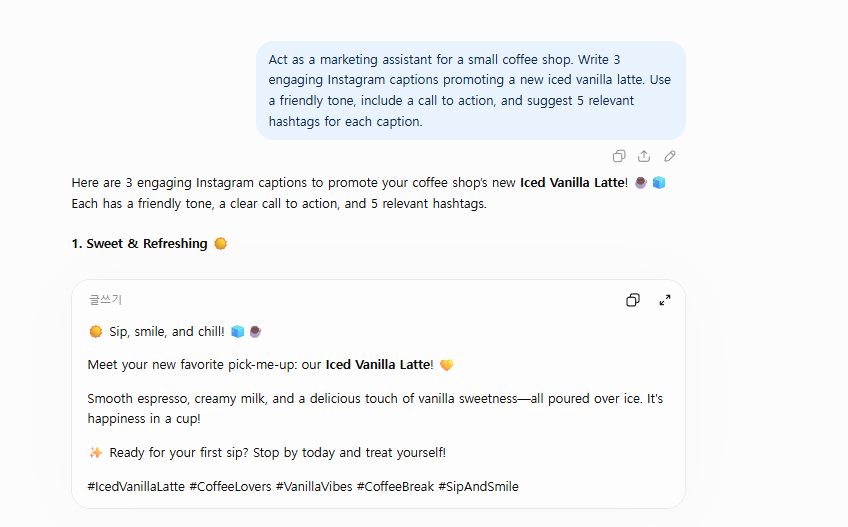
Act as a marketing assistant for a small coffee shop. Write 3 engaging Instagram captions promoting a new iced vanilla latte. Use a friendly tone, include a call to action, and suggest 5 relevant hashtags for each caption.
What ChatGPT generated
ChatGPT created three promotional captions with different tones:
- Sweet and refreshing
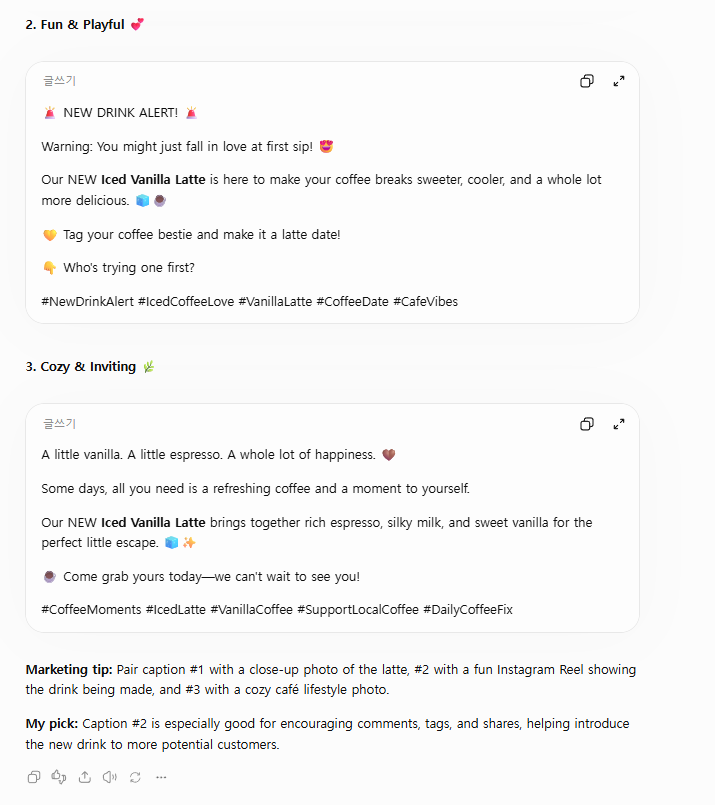
- Fun and playful
- Cozy and inviting
Each caption included a call to action and five hashtags.
One suggested approach encouraged customers to tag a friend and plan a coffee date.
The response also recommended pairing different captions with suitable photographs or short videos.
What we learned
ChatGPT can quickly generate multiple creative directions for the same product.
However, the business owner still needs to check the product details, adapt the language to the brand, and select appropriate images.
Practical tip: Ask ChatGPT to create captions for different customer groups, such as students, office workers, or families.
2. Draft a Customer Service Email
Best for: Customer communication
Customers expect clear and professional updates when an order is delayed.
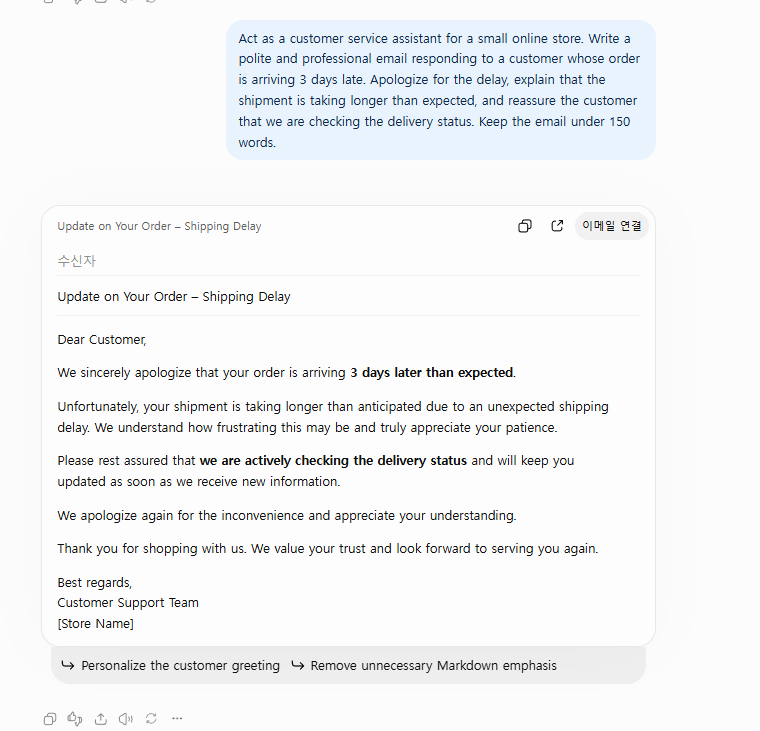
We tested whether ChatGPT could create an email for a customer whose delivery was three days late.
Our tested prompt
Act as a customer service assistant for a small online store. Write a polite and professional email responding to a customer whose order is arriving 3 days late. Apologize for the delay, explain that the shipment is taking longer than expected, and reassure the customer that we are checking the delivery status. Keep the email under 150 words.
What ChatGPT generated
The response included:
- A professional subject line
- An apology for the delay
- An explanation of the shipping situation
- Reassurance about checking delivery status
- A polite closing and store-name placeholder
What we learned
ChatGPT can help produce a useful first draft for routine customer communication.
But a business should never claim to have checked a shipment unless that action has actually taken place.
Before sending an AI-generated email, confirm the order details, shipping information, and any promises made to the customer.
Practical tip: Create reusable templates for common situations such as delayed shipping, returns, refunds, and product inquiries.
3. Write Product Descriptions for an Online Store
Best for: E-commerce content
Product descriptions help customers understand what a product is and why it may be useful.
We tested ChatGPT with a reusable stainless steel water bottle.
Our tested prompt
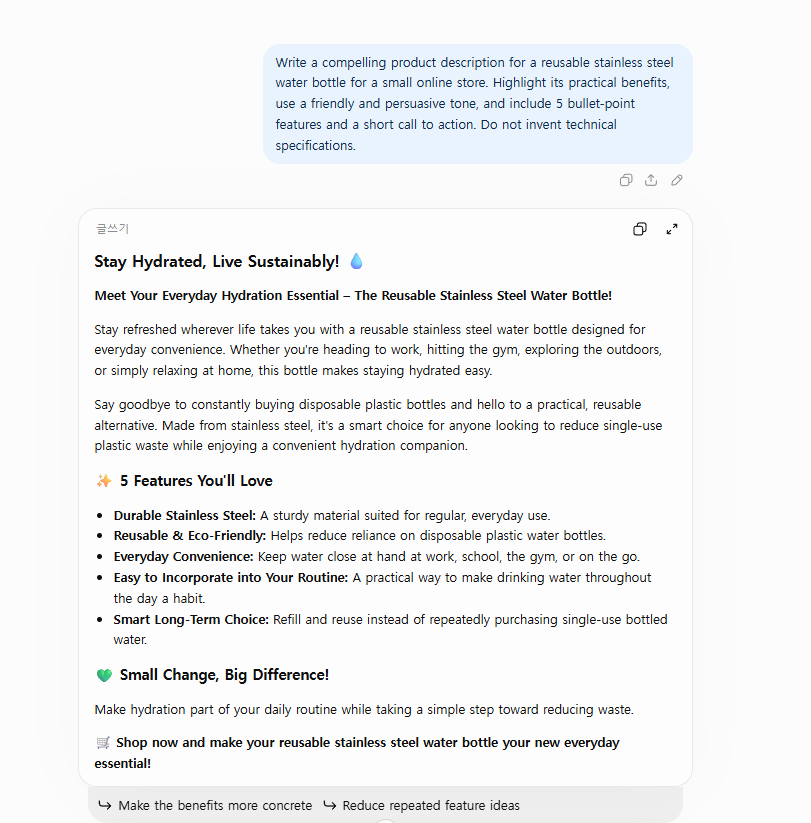
Write a compelling product description for a reusable stainless steel water bottle for a small online store. Highlight its practical benefits, use a friendly and persuasive tone, and include 5 bullet-point features and a short call to action. Do not invent technical specifications.
What ChatGPT generated
ChatGPT produced a product description with a headline, benefit-focused paragraphs, five bullet points, and a call to action.
The content emphasized everyday convenience, reusability, and reducing reliance on disposable bottles.
What we learned
ChatGPT is useful for creating a first draft, but product descriptions require careful fact-checking.
Even when instructed not to invent specifications, an AI response may include broad claims about durability, sustainability, or performance that should be verified against the actual product.
Practical tip: Provide verified product specifications, materials, dimensions, and care instructions before asking ChatGPT to write the description.
4. Generate SEO-Friendly Blog Post Ideas
Best for: Content marketing
Finding useful topics is an important part of growing a business blog.
We tested whether ChatGPT could generate ideas based on a specific audience and search intent.
Our tested prompt
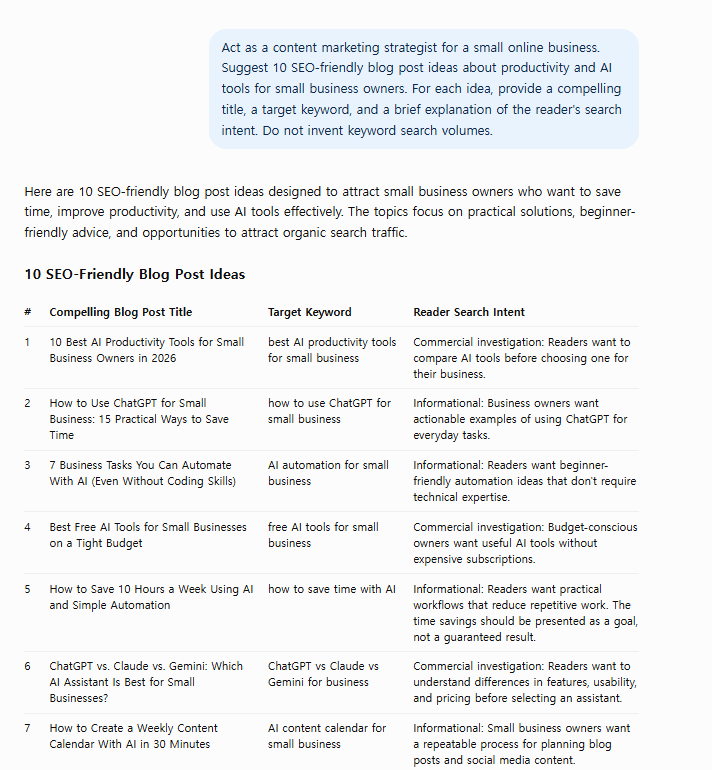
Act as a content marketing strategist for a small online business. Suggest 10 SEO-friendly blog post ideas about productivity and AI tools for small business owners. For each idea, provide a compelling title, a target keyword, and a brief explanation of the reader’s search intent. Do not invent keyword search volumes.
What ChatGPT generated
ChatGPT suggested ten blog topics and organized them with target keywords and search intent.
Examples included:
- How to Use ChatGPT for Small Business
- Business Tasks You Can Automate With AI
- How to Create a Weekly Content Calendar With AI
- AI Tools for Email Marketing
- AI Customer Service for Small Businesses
It also recommended prioritizing practical, specific topics before broader competitive keywords.
What we learned
ChatGPT can support content brainstorming and help organize ideas into a publishing plan.
However, suggested keywords are not proof of actual search demand. Keyword volume, ranking difficulty, and competition require separate research.
Practical tip: Combine ChatGPT’s ideas with Google Search Console data and other reliable keyword research tools.
5. Build a Weekly Business Productivity Schedule
Best for: Time management
Small business owners often switch between customer support, order fulfillment, marketing, and planning.
We tested whether ChatGPT could organize these responsibilities into a manageable workweek.
Our tested prompt
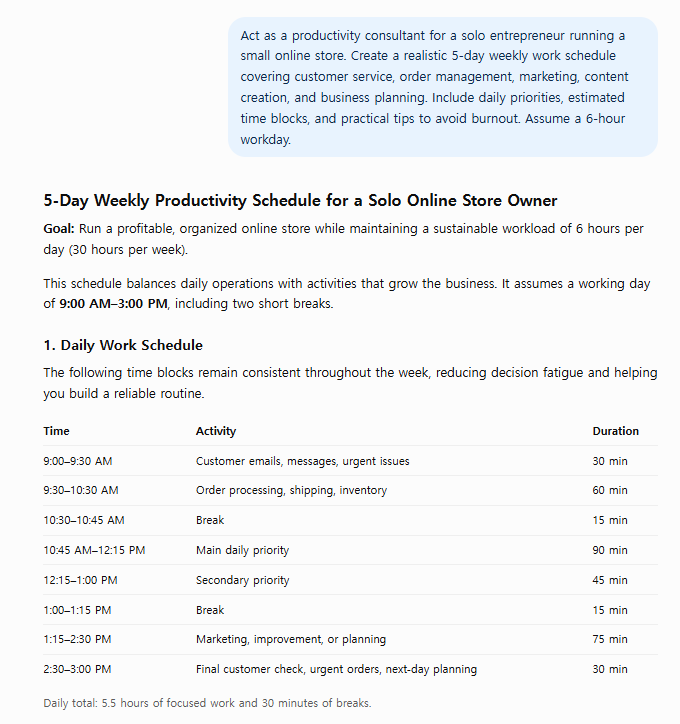
Act as a productivity consultant for a solo entrepreneur running a small online store. Create a realistic 5-day weekly work schedule covering customer service, order management, marketing, content creation, and business planning. Include daily priorities, estimated time blocks, and practical tips to avoid burnout. Assume a 6-hour workday.
What ChatGPT generated
The response created a Monday-to-Friday schedule based on a 9 AM to 3 PM workday.
It allocated time for:
- Customer service
- Order management
- Content creation
- Marketing
- Business planning
- Short breaks and daily reviews
It also assigned different priorities to each weekday and included a weekly checklist.
What we learned
ChatGPT can help turn a broad productivity goal into a structured routine.
The generated schedule is a starting point, not a personalized operating plan. Actual workloads, order volumes, and customer expectations will affect how practical it is.
Practical tip: Tell ChatGPT your real working hours, busiest periods, and daily responsibilities to receive a more relevant schedule.
Part 2: Five More ChatGPT Workflows to Try
The following examples are suggested applications with ready-to-use prompts. They were not part of our five documented tests.
6. Create a Simple Marketing Campaign
Best for: Promotions and product launches
ChatGPT can help outline a promotional campaign, including messages for different channels.
Example prompt
Create a 7-day marketing plan for a small online store launching a new reusable water bottle. Include daily promotional activities, social media ideas, and email campaign suggestions. Keep the plan realistic for a solo entrepreneur.
How to use the result: Review the campaign, choose activities that fit your budget, and confirm all product claims before publishing.
7. Prepare a Frequently Asked Questions Page
Best for: Customer support
A clear FAQ page can help customers find information about shipping, returns, and products.
Example prompt
Help me organize an FAQ page for a small online store. Suggest common customer questions about shipping, returns, payments, and product care. Do not invent store policies. Use placeholders wherever actual policy information is required.
How to use the result: Replace every placeholder with your real policies and review the wording for accuracy.
8. Plan an Email Newsletter
Best for: Customer engagement
Email newsletters can help businesses share updates, educational content, and relevant promotions.
Example prompt
Create a friendly monthly email newsletter outline for a small coffee shop. Include a subject line, opening message, featured product section, helpful coffee tip, and call to action. Do not invent discounts or events.
How to use the result: Add verified offers, product details, and relevant links before sending.
9. Brainstorm Customer Survey Questions
Best for: Customer feedback
Understanding customer needs can help businesses improve products and services.
Example prompt
Create a short customer satisfaction survey for a small online store. Include 7 clear questions covering shopping experience, delivery, product satisfaction, and suggestions for improvement. Avoid leading questions.
How to use the result: Choose the most relevant questions and collect feedback through an appropriate survey tool.
10. Create a Monthly Business Review Checklist
Best for: Business planning
A monthly review can help business owners understand what worked and what needs attention.
Example prompt
Create a monthly business performance review checklist for a solo online store owner. Include sales, expenses, customer feedback, marketing results, inventory, and next-month priorities. Do not invent financial figures.
How to use the result: Add actual business data and use the checklist to identify areas for improvement.
Quick Comparison: 10 ChatGPT Uses for Small Businesses
| Use case | Main benefit | Our status |
|---|---|---|
| Instagram captions | Marketing content drafts | Tested |
| Customer service emails | Communication drafts | Tested |
| Product descriptions | E-commerce copywriting | Tested |
| Blog topic ideas | Content planning | Tested |
| Weekly schedules | Work organization | Tested |
| Marketing campaigns | Promotion planning | Suggested |
| FAQ pages | Support documentation | Suggested |
| Email newsletters | Customer communication | Suggested |
| Customer surveys | Feedback collection | Suggested |
| Monthly reviews | Business planning | Suggested |
How to Write Better ChatGPT Prompts
The quality of a ChatGPT response often depends on the instructions provided.
A useful prompt usually includes four elements.
1. Role: Explain what kind of assistant you need.
Example: “Act as a customer service assistant.”
2. Task: Describe the exact work you want completed.
Example: “Write an email about a delayed order.”
3. Context: Provide relevant details.
Example: “The order is arriving three days late.”
4. Format: Specify the preferred output.
Example: “Keep the email under 150 words and use a professional tone.”
You can also add restrictions such as “Do not invent product specifications” or “Use placeholders for unknown details.”
These instructions reduce ambiguity, although they do not guarantee that every response will be accurate.
Common Mistakes to Avoid
Publishing AI content without reviewing it
Always check factual claims, grammar, tone, and relevance before using generated material.
Sharing sensitive customer information
Avoid entering private customer records or confidential business details without understanding the service’s data handling and your privacy obligations.
Assuming AI-generated marketing claims are true
ChatGPT may produce convincing statements about products or services. Verify them before publishing.
Expecting guaranteed business results
AI-generated content does not guarantee more sales, higher search rankings, or a particular number of hours saved.
Using too many tools at once
Start with one or two repeatable workflows and evaluate whether they genuinely improve your business operations.
Is ChatGPT Worth Using for Small Businesses?
ChatGPT can be a practical tool for small business owners who frequently write, plan, or organize information.
Our five tests demonstrated that it could generate different types of business content from clearly written prompts.
However, we did not measure time savings against manual work, evaluate customer outcomes, or test long-term business performance.
The most useful approach is to begin with a specific task, review the output carefully, and measure whether the tool improves your own workflow.
Final Thoughts
Learning how to use ChatGPT for small business does not require technical expertise.
You can start by drafting a customer email, creating a few social media captions, or organizing next week’s work.
As you become more comfortable with prompting, explore additional uses such as content planning, FAQs, newsletters, and business reviews.
Start small, test the results, and keep human judgment at the center of your business decisions.
For more AI tools and comparisons, explore our related guides:
- Best AI Tools for Small Businesses in 2026
- ChatGPT vs Claude in 2026
- 7 Best Free AI Tools for Small Business Owners in 2026
Disclosure: Some links on AIBizCompass may be affiliate links. If you purchase through a qualifying affiliate link, we may earn a commission at no additional cost to you.